
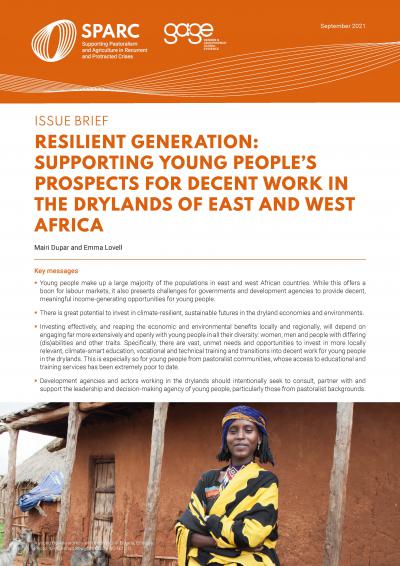
Resilient generation: supporting young people’s prospects for decent work in the drylands of East and West Africa
Keywords:
young people, jobs and livelihoods, drylands, climate changeSynopsis
This issue brief summarises key findings and recommendations from the research report ' Resilient Generation: supporting young people’s prospects for decent work in the drylands of east and west Africa '.
Key messages from the brief include:
- The ‘Resilient Generation’ report reviews opportunities available for investment and programmes to enhance young people’s readiness and prospects for decent work in the drylands of east and west Africa;
- Pastoralism traditionally has been the dominant livelihood in the drylands of east and west Africa. Pastoralism and rural livelihoods are highly exposed to climate variability and change. In this context, ‘decent work’ now and in the future will be defined as being responsive to climate change, as well as providing a secure and reliable income;
- There is a large gap in programme interventions that address the nexus of youth, climate, agriculture and pastoralism, and decent work. This provides government and practitioners with a tremendous opportunity to do more programming at this nexus and to do it well;
- There are valuable operational lessons on how to improve the relevance of education, vocational training, and transitions to decent work, arising from the few nexus programmes that have been evaluated;
- It is important to expand the narrative around young people’s livelihood options in drylands, within and beyond agriculture and pastoralism, to encompass a wide suite of decent jobs in climate-adaptive, low-carbon fields. Such work must underpin economic growth in these regions. As investments in infrastructure and markets shift in response to climate science, climate realities and commitments to the Paris Agreement so, too, must investments in young workers’ skills, knowledge and opportunities, to keep pace.
Downloads
Published
30 September 2021
Series
Online ISSN
2977-9642
Categories
Copyright (c) 2012 SPARC Knowledge
License

This work is licensed under a Creative Commons Attribution-NonCommercial-NoDerivatives 4.0 International License.
Details about this monograph
doi
10.61755/WCEH5477