
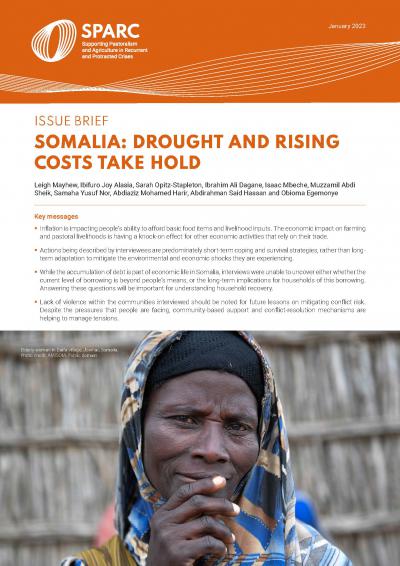
Somalia: drought and rising costs take hold
Keywords:
Somalia, fragile and conflict-affected states, agriculture, trade, trade policySynopsis
The economic, environmental, political and social contexts at the local, national and regional levels are continually evolving, and regional to global events such as the economic repercussions of Covid-19 are being felt at the local level.
In this brief, we aimed to capture how pastoralists, agropastoralists and farmers are coping with and adapting their livelihoods to this dynamism.
The key messages are:
- Inflation is affecting the ability of pastoralists, agropastoralists and farmers to afford basic food items and livelihood inputs. The economic impact on farming and pastoral livelihoods is having a knock-on effect for other economic activities, which depend on their trade.
- Interviewees described actions that are predominately short-term coping and survival strategies, rather than long-term adaptation to mitigate shocks being experienced.
- Whilst the accumulation of debt is part of economic life in Somalia, our interviews were unable to uncover if the current level of borrowing is beyond people’s means or what the long-term implications of this borrowing means for households. Answering these questions will be important for understanding household recovery.
- A lack of violence in the communities interviewed should be noted for future lessons of mitigating future conflict risk. Despite the pressures that people are facing, community-based support and conflict resolution mechanisms are helping to manage tensions.
Downloads
Published
18 January 2023
Series
Online ISSN
2977-9642
Categories
Copyright (c) 2023 SPARC Knowledge
License

This work is licensed under a Creative Commons Attribution-NonCommercial-NoDerivatives 4.0 International License.
Details about this monograph
doi
10.61755/RWOD5820