
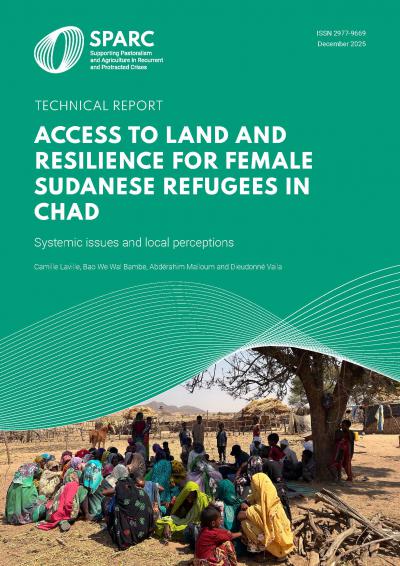
Access to land and resilience for female Sundanese refugees in Chad: systemic issues and local perceptions
Keywords:
Chad, women, land use, migration, local government, Sudan conflict, SudanSynopsis
In 2025, over a million Sudanese refugees, mostly women and children, live in eastern Chad, some for over 15 years. The Chad government and partners aim to support their autonomy by providing land access, but this is mainly through agreements with host communities with unclear conditions.
This study explores Sudanese refugee women’s land access in eastern Chad, analysing host community perceptions. It examines systemic barriers, women’s social characteristics, land access, and opportunities for improved coordination.
Data from 30 focus groups with over 300 people from refugee camps in February 2025, supplemented by literature reviews, national budget studies, and interviews with stakeholders, reveals:
- Chad and partners lack clear objectives for women’s land access, hindering their commitment.
- Refugees and hosts recognise that pregnant or single refugee women with young children or disabled dependents have less land access. Being young with close family support, especially adolescents, is seen as a key advantage. However, the commodification of land exacerbates gender inequalities by preventing refugee women without male guarantors from accessing land. This confusion between access and use of land also creates tension between communities, hindering peaceful coexistence and village development.
Policy implications include strengthening the integration of land tenure issues for host communities and refugees in national climate strategies. Attention should be paid to inequalities in access linked to household composition in national strategies for the East of Chad, raising awareness among local authorities, and establishing legal mechanisms to address gender-based barriers. Support for equitable access to seeds and agricultural tools adapted to gender and local realities is also crucial to avoid adverse local effects and supply disruptions. Prioritising areas where refugee camps encroach on host lands or are affected by land commodification in rehabilitated land donation programs is essential. A joint assessment of road and water infrastructure with host communities is needed to better target investments and reduce feelings of injustice.
This report is also available in French.
Published
Series
Online ISSN
Categories
License

This work is licensed under a Creative Commons Attribution-NonCommercial-NoDerivatives 4.0 International License.