
Supporting pastoralists through AfriScout Steward and Regen: Impact evaluation
Keywords:
pastoralist, climate change, jobs and livelihoods, gender equality, social inclusion, AfriScout, African drylandsSynopsis
Pastoralism is an increasingly precarious livelihood in East Africa’s arid and semi-arid regions due to climate-related disasters, armed conflict, livestock diseases, macroeconomic shocks and growing populations. Consequently, there is a critical need for innovations that enhance pastoralists’ resilience and adaptability.
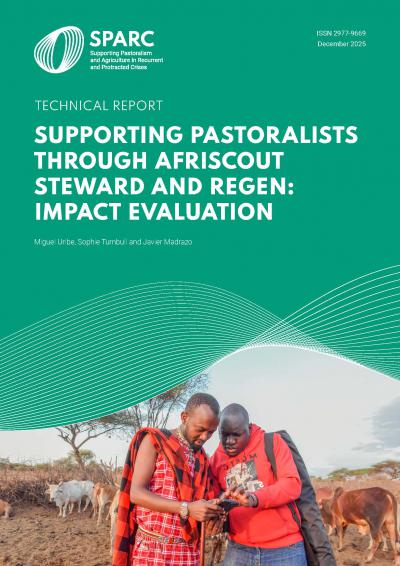
The AfriScout (AS) programme – devised and implemented by Global Communities – supports pastoralists through two intervention models: AfriScout Steward, a digital app implemented in Kenya that provides satellite and crowd-sourced information on rangeland conditions to inform grazing and migration decisions; and AfriScout Regen, which provides more intensive and localised grazing support at a community level in Ethiopia using a unique version of the adaptive multi-paddock (AMP) approach within defined regenerative grazing units (RGU).
Causal Design conducted an impact evaluation (IE) to understand the causal impacts of the two AS models (Causal Design, 2025). Primarily, the evaluation sought to identify the attributable outcomes of AS on pastoralist decision-making and subsequent impacts on rangeland conditions and herd conditions. This SPARC Technical Report summarises key findings and evidence-based recommendations for AS implementers and policy-makers.
Published
Series
Online ISSN
Categories
License

This work is licensed under a Creative Commons Attribution-NonCommercial-NoDerivatives 4.0 International License.