
Financing climate technology transfer
Keywords:
Climate finance, Energy, Private sector, Climate change, GlobalSynopsis
Mitigating dangerous climate change and adapting to its impacts will rely in large part on the application of new technologies. Uses range from producing renewable energy to reducing farmers' reliance on dwindling water resources.
There is strong interest in better understanding how development partners can most effectively encourage and finance technology transfer in developing countries. We present key insights, drawing on the experience of the Global Environment Facility (GEF), an operating entity of the financial mechanism of the UNFCCC.
Key messages
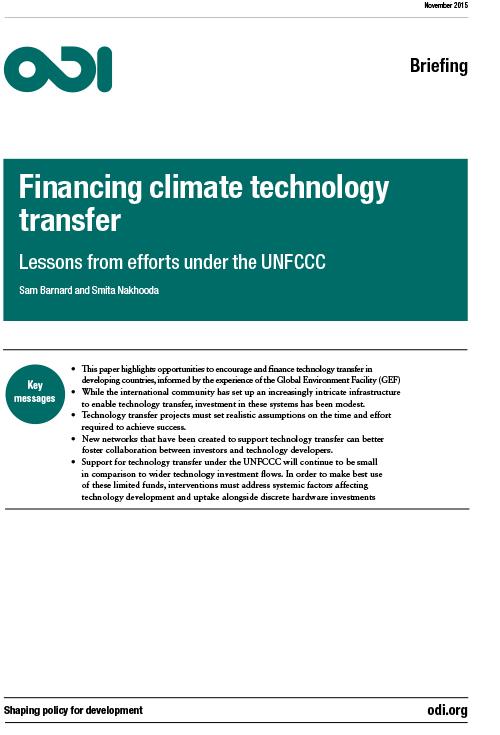
- While the international community has set up an increasingly intricate infrastructure to enable technology transfer, investment in these systems has been modest.
- Technology transfer projects must set realistic assumptions on the time and effort required to achieve success.
- New networks that have been created to support technology transfer can better foster collaboration between investors and technology developers.
- Support for technology transfer under the UNFCCC will continue to be small in comparison to wider technology investment flows. To make best use of these limited funds, interventions must address systemic factors affecting technology development and uptake alongside discrete hardware investments.
Downloads
Published
26 November 2015
Series
Online ISSN
0140-8682
Categories
Copyright (c) 2015 ODI eLibrary
License

This work is licensed under a Creative Commons Attribution-NonCommercial-NoDerivatives 4.0 International License.
Details about this monograph
Publication date (01)
2015
doi
10.61755/BWBW4010