
Advancing the governance of extractives at the local level: towards politically smart support
Keywords:
Governance, Monitoring, evaluation and learning, Politics, Middle East and North Africa, sub-Saharan AfricaSynopsis
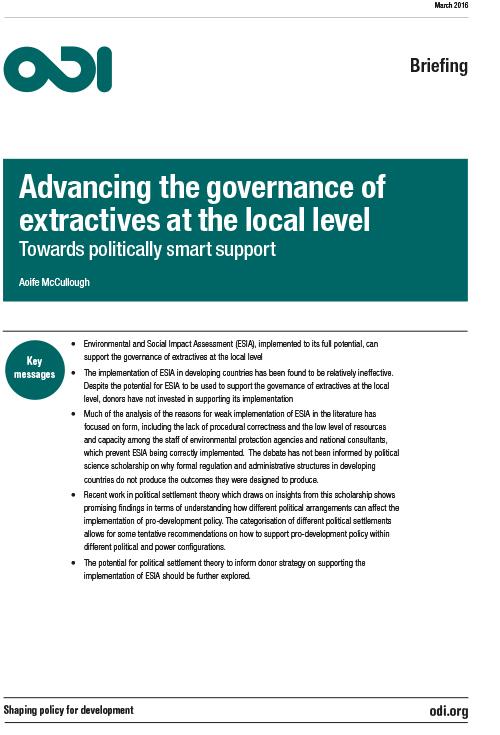
Environmental and Social Impact Assessments (ESIA) can support the governance of extractives at the local level. However, the implementation of ESIA in developing countries has been found to be relatively ineffective. Despite the potential for ESIA to be used to support the governance of extractives at the local level, donors have not invested in supporting its implementation.
Much of the analysis of the reasons for weak implementation of ESIA has focused on the lack of procedural correctness and capacity of government staff, which prevents ESIA being correctly implemented. The debate has not been informed by political science scholarship on why formal regulation and administrative structures in developing countries do not produce the outcomes they were designed to produce.
This briefing responds to this analytical gap and suggests that working with the political economy environment can increase the effecitveness of ESIA. In particular, it stresses that ESIA implementation could benefit from learnings from political settlement theory, which emphasises how a society's institutional structure and the policies that flow from it reflect the interests of powerful groups in society. Political settlements theory is a useful starting point for thinking about whether ESIA is likely to be implemented by a given country and its potential to inform donor strategy should be further explored.
Downloads
Published
Series
Online ISSN
Categories
License

This work is licensed under a Creative Commons Attribution-NonCommercial-NoDerivatives 4.0 International License.