
Women on the move: migration, gender equality and the 2030 Agenda for Sustainable Development
Keywords:
Internal displacement, Refugees, Global, Middle East and North Africa, Urban, Migration, Jobs & livelihoodsSynopsis
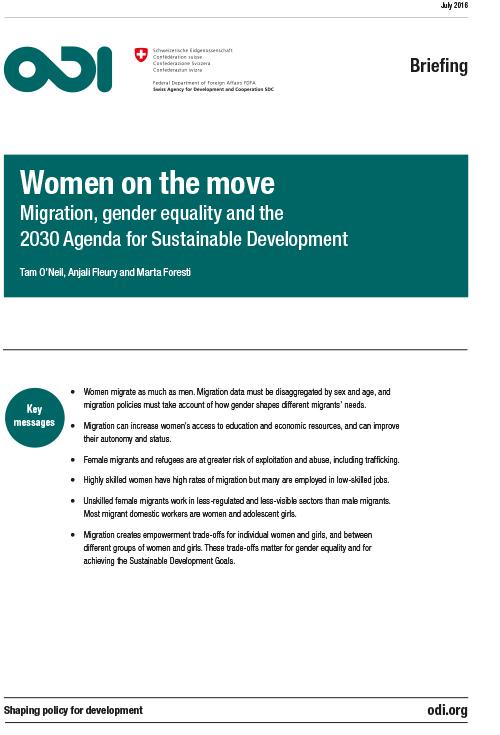
Women migrate as much as men. Migration data must be disaggregated by sex and age, and migration policies must take account of how gender shapes different migrants' needs. Migration can increase women's access to education and economic resources, and can improve their autonomy and status. Female migrants and refugees are at greater risk of exploitation and abuse, including trafficking.Highly skilled women have high rates of migration but many are employed in low-skilled jobs. Unskilled female migrants work in less regulated and less visible sectors than male migrants. Most migrant domestic workers are women and adolescent girls. This brief presents an overview and analysis of the opportunities, risks and vulnerabilities for women migrants and refugees. It describes the realities of women migrating around the world, specifically the experiences of both high-skilled and low-skilled migrant workers employed in a range of 'care' professions, from domestic workers to nurses and doctors. Migration creates empowerment trade-offs for individual women and girls, and between different groups of women and girls. These trade-offs matter for gender equality and for achieving the Sustainable Development Goals (SDGs).
Downloads
Published
Series
Online ISSN
Categories
License

This work is licensed under a Creative Commons Attribution-NonCommercial-NoDerivatives 4.0 International License.