
Social Safety Nets, Indonesia
Keywords:
Human rights, Inequality, Social exclusion, Social protection, Asia, IndonesiaSynopsis
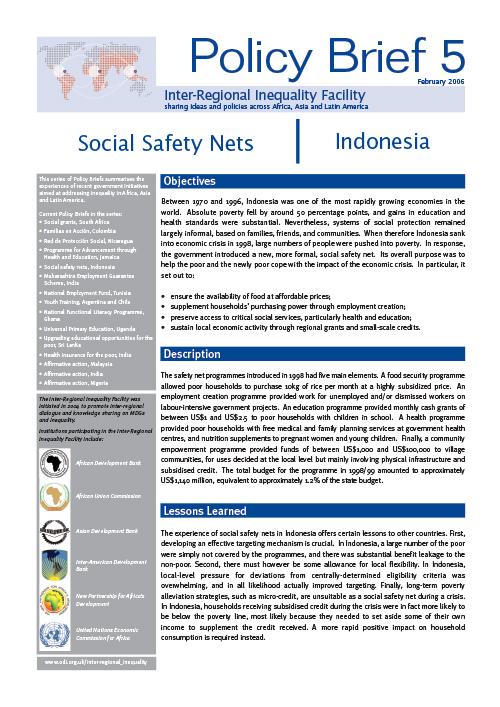
The safety net programmes introduced in 1998 had five main elements. A food security programme allowed poor households to purchase 10kg of rice per month at a highly subsidized price. An employment creation programme provided work for unemployed and/or dismissed workers on labour-intensive government projects. An education programme provided monthly cash grants of between US$1 and US$2.5 to poor households with children in school. A health programme provided poor households with free medical and family planning services at government health centres, and nutrition supplements to pregnant women and young children. Finally, a community empowerment programme provided funds of between US$1,000 and US$100,000 to village communities, for uses decided at the local level but mainly involving physical infrastructure and subsidised credit. The total budget for the programme in 1998/99 amounted to approximately US$1,140 million, equivalent to approximately 1.2% of the state budget.
Downloads
Published
Series
Online ISSN
Categories
License

This work is licensed under a Creative Commons Attribution-NonCommercial-NoDerivatives 4.0 International License.