
Adjustment in Africa: Lessons from Ghana
Keywords:
Economic growth, Public finance, Ghana, sub-Saharan AfricaSynopsis
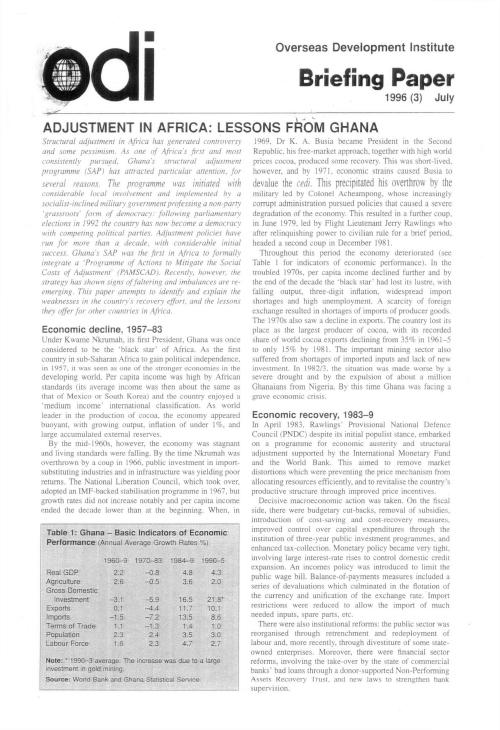
Structural adjustment in Africa has generated controversy and some pessimism. As one of Africa's first and most consistently pursued, Ghana's structural adjustment programme (SAP) has attracted particular attention, for several reasons. The programme was initiated with considerable local involvement and implemented by a socialist-inclined military government professing a non-party 'grassroots' form of democracy: following parliamentary elections in 1992 the country has now become a democracy with competing political parties. Adjustment policies have run for more than a decade, with considerable initial success. Ghana's SAP was the first in Africa to formally integrate a 'Programme of Actions to Mitigate the Social Costs of Adjustment' (PAMSCAD). Recently, however, the strategy has shown signs of faltering and imbalances are re-emerging. This paper attempts to identify and explain the weaknesses in the country's recovery effort, and the lessons they offer for other countries in Africa.
Downloads
Published
Series
Online ISSN
Categories
License

This work is licensed under a Creative Commons Attribution-NonCommercial-NoDerivatives 4.0 International License.