
Climate extremes and child rights in South Asia: a neglected priority
Keywords:
Adaptation, Resilience, Climate changeSynopsis
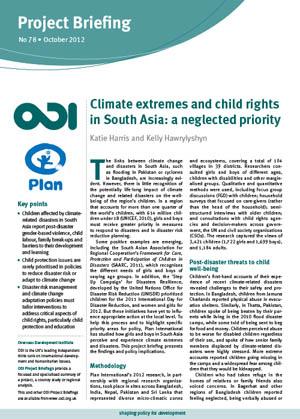
Climate change and disasters in South Asia, like flooding in Pakistan and cyclones in Bangladesh, are evident. However, the long-term impact on children’s well-being is often overlooked. As a region with over a quarter of the world’s children, girls and boys must be prioritised in disaster response and risk reduction planning. Positive examples include the South Asian Association for Regional Cooperation’s Framework for Care, Protection, and Participation of Children in Disasters, which recognises gender differences. The ‘Step Up Campaign’ for Disasters Resilience prioritised children in 2011 and women and girls in 2012. However, these initiatives haven’t influenced local action. Plan International studied how girls and boys in South Asia perceive and experience climate extremes and disasters. This briefing presents findings and policy implications. Key points: Children affected by climate-related disasters in South Asia report gender-based violence, child labour, family break-ups, and barriers to development and learning. Child protection issues are rarely prioritised in disaster risk reduction or climate change adaptation policies. Disaster risk management and climate change adaptation policies must tailor interventions to address critical aspects of child rights, particularly child protection and education.
Downloads
Published
Series
Online ISSN
Categories
License

This work is licensed under a Creative Commons Attribution-NonCommercial-NoDerivatives 4.0 International License.