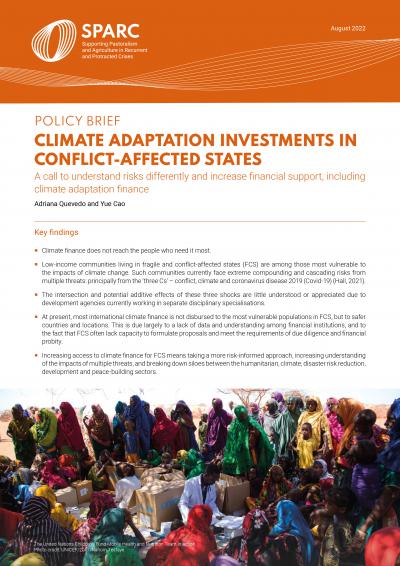
Climate adaptation investments in conflict-affected states
Keywords:
climate adaptation, climate finance, fragile and conflict-affected statesSynopsis
This paper aims to influence policy-makers in the climate, humanitarian and peace-building communities of practice, as well as country governments that are facing fragile and conflict-affected situations, to re-think the risks and increase financial allocations to the least developed country (LDC) sub-group of fragile and conflict-affected states (FCAS) that are most vulnerable to the impacts of climate change.
Throughout this policy brief it is key to note current understandings of the interplay between climate change and conflict. Climate change can undermine efforts to secure peace and stability, with climate hazards not only directly impacting people and their livelihoods, but also indirectly exacerbating existing conflict and fragility, and in turn creating new conflicts. However, this is highly context specific and poses uncertainties in attribution. Conflict and fragility can increase people’s vulnerability to climate change and constrain their ability to adapt. For example, livelihoods can be lost, reducing the affordability of adaptation, and people often migrate to areas that are more vulnerable to climate risks.
The type and status of conflict and fragility affects the degree of people’s intersecting vulnerabilities to other threats, with the role of conflict as a driver of vulnerability to climate change possibly becoming more important than the role of climate change as a mediating factor in conflict in many contexts. Covid-19 has amplified people’s vulnerabilities in FCAS, limiting people’s access to adequate public services and affecting livelihoods. Therefore there is a need for financial providers of climate-related activities in FCAS to acknowledge the complexities behind localised interplay from the threats of conflict and climate change, and therefore take risk-informed approaches.
Downloads
Published
Series
Online ISSN
Categories
License

This work is licensed under a Creative Commons Attribution-NonCommercial-NoDerivatives 4.0 International License.