
Participatory planning in East Africa’s drylands, take two: from chasing an illusory panacea to practical learning
Keywords:
participatory planning, Ward Development Planning, USAID, KenyaSynopsis
Existing literature paints a confusing picture, where there is neither consensus on whether participatory planning works, nor theory to explain uneven impact. How and when can participatory planning bring local voices into decision-making? Can this make planning more equitable, build resilience and improve governance? To what extent does the effectiveness of interventions depend on local context? Beyond formal design, to what extent does success rely on discretion by local implementers?
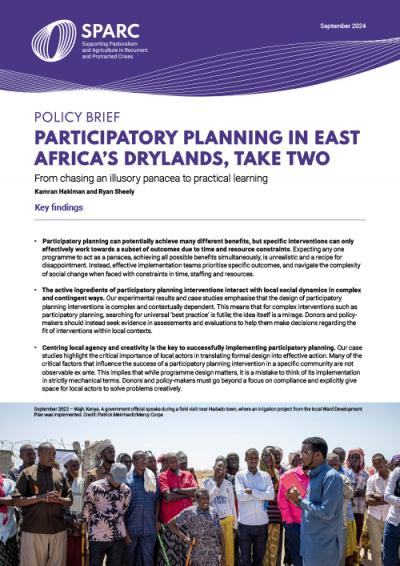
This policy brief aims to address those questions by examining Ward Development Planning (WDP), a participatory planning model funded by the United States Agency for International Development (USAID) and implemented in northern Kenya from 2017 to 2022. Through mixed methods, combining an evaluation, survey experiments, and in-depth case studies across five counties in Kenya, we not only evaluate the overall impact of WDP, but also use case studies and survey experiments, to examine causal mechanisms to explain why WDP had uneven impacts.
Published
Series
Online ISSN
Categories
License

This work is licensed under a Creative Commons Attribution-NonCommercial-NoDerivatives 4.0 International License.